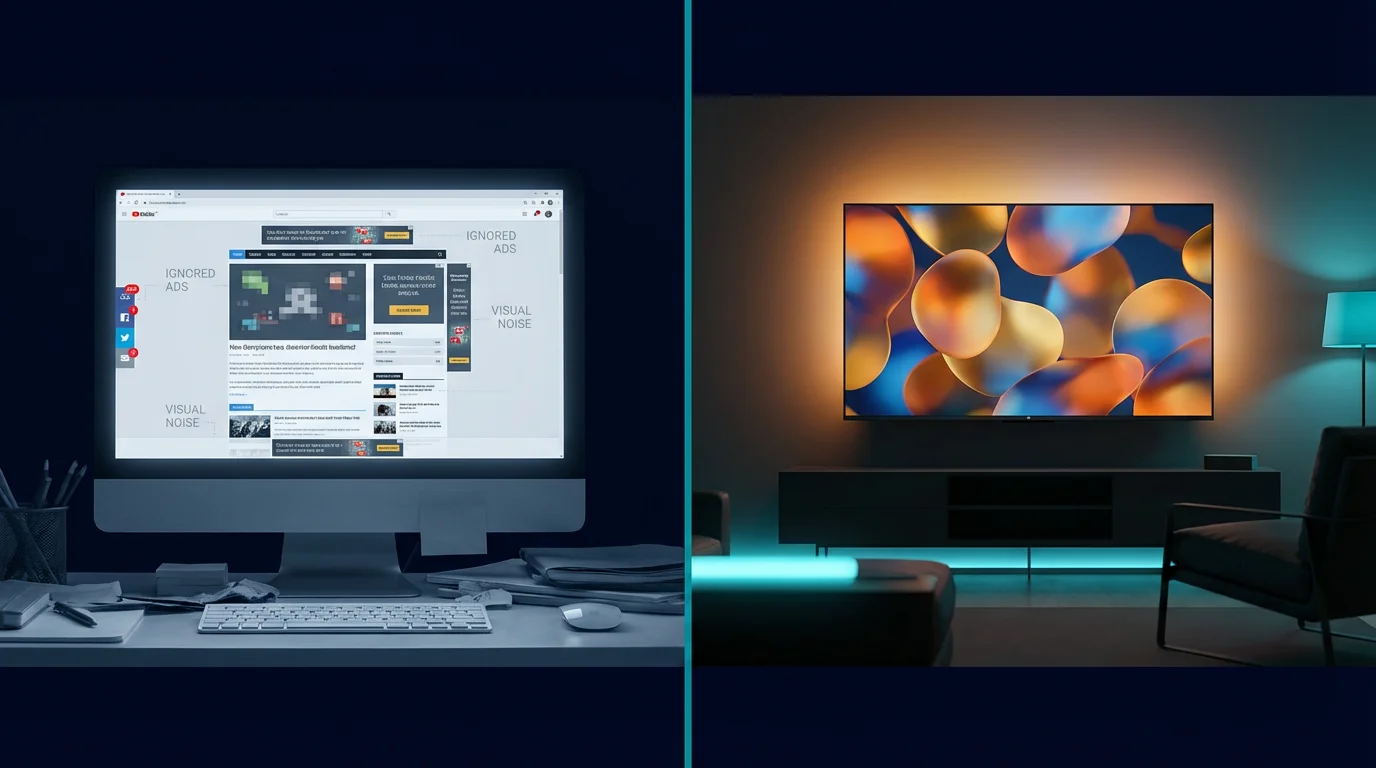
B2B marketers spend heavily on programmatic display. It’s familiar, it scales, and every platform makes it easy to buy. But there’s a growing problem: nobody’s looking at the ads.
Display click-through rates for B2B average 0.46% according to WordStream’s analysis of thousands of ad accounts. And click-through is the generous metric. Lumen Research eye-tracking data shows that only 30% of viewable display ads are actually looked at. The rest render on a page and attract zero attention.
CTV (Connected TV) operates in a different environment entirely. Full-screen, sound-on, lean-back viewing. Your ad runs during a show someone chose to watch. It’s not competing with other content on the page. It’s the content.
This isn’t a piece that says one channel is dead and the other is the future. Both have a role. But they play fundamentally different roles for B2B, and understanding where each wins changes how you allocate budget.
Quick Comparison
| Factor | Programmatic Display | CTV |
|---|---|---|
| Ad format | Banners, rich media, native units | Full-screen video (15s or 30s) |
| Viewing environment | Lean-forward, task-oriented, scroll-past | Lean-back, entertainment-focused, full attention |
| B2B targeting | IP-based, cookie-based, contextual | Account lists, firmographics, job title audiences |
| Ad fraud risk | Higher (bots, MFA sites, ad stacking) | Lower on premium streaming inventory |
| Primary measurement | Clicks, CTR, conversions | Website visits by account, brand lift, halo on other channels |
| Creative format | Static images, simple animations | Video (doesn’t need to be a Super Bowl spot) |
| Buying committee reach | Individual browser or device | Household-level (multiple decision-makers) |
| Best role in the funnel | Retargeting, bottom-funnel conversion | Awareness, consideration, halo effect on other channels |
| Retargeting capability | Strong (pixel-based, immediate) | Best paired with online video to retarget CTV viewers on desktop and mobile |
What is Programmatic Display?
Programmatic display is automated buying of banner ads, rich media, and native units across websites and apps. You set targeting criteria (firmographics, intent data, IP targeting, contextual signals), and the system bids on ad placements in real time as users browse the web.
For B2B, programmatic display has been a staple for over a decade. It’s the workhorse of retargeting and always-on campaigns. Platforms serve ads across publisher networks, trade publications, news sites, and content destinations your target audience visits during the workday.
What it does well: Scale, retargeting, always-on presence, and direct-response tracking. When a prospect visits your website and leaves without converting, display retargeting keeps your brand visible as they browse elsewhere.
The growing problem: The web environment has changed. At least 30% of internet users globally use ad blocking tools, per GWI research. Made-for-advertising (MFA) sites consume a meaningful share of programmatic spend. And most display impressions that do render go unnoticed in a sea of content, sidebars, and tabs.
The identity infrastructure behind display targeting is also shifting. Google reversed its plans to deprecate third-party cookies in Chrome, but Safari and Firefox still block them. Meanwhile, Google began allowing advertisers to use IP addresses for targeting and measurement in early 2025, a reversal of its previous anti-fingerprinting stance. That shift actually benefits CTV’s household-level targeting model more than it helps display, since IP-based matching is already core to how CTV identifies and reaches accounts.
What is CTV Advertising?
Connected TV (CTV) delivers video ads within streaming content on internet-connected televisions. When someone watches ad-supported content on Hulu, Disney+, Peacock, ESPN+, or any of the hundreds of streaming services available today, they’re a CTV viewer.
CTV ads are 15 or 30-second video spots. Full-screen, sound-on. They’re bought programmatically with digital targeting behind them. Every impression is trackable: you know it was served, you know it completed, and you can tie it back to specific targeting criteria.
What it does well: Awareness, consideration, and creating a halo effect that lifts performance across every other channel in your mix. 46% of consumers trust TV ads, compared to 27% for social media, per the 2025 Credos Trust Tracker. CTV inherits that trust while adding digital precision.
For B2B specifically: Account-based CTV targeting lets you start with a target account list or build a firmographic and job title audience. You’re not buying demographics. You’re reaching the buying committees at specific companies, or the right roles at the right types of companies.
The Four Differences That Matter for B2B
1. The viewing environment is fundamentally different
Display ads compete for attention in a lean-forward, task-oriented environment. Your prospect is reading an article, checking email, or working in a SaaS tool. Your banner ad is a peripheral distraction at best.
CTV ads run in a lean-back, entertainment-focused environment. Your prospect is watching a show on their couch. The ad is full-screen. There’s no skip button on premium inventory. There’s no other content competing for their eyes.
For B2B, where brand consideration cycles run months and buying committees include multiple decision-makers, that attention gap compounds. A banner ad your CFO scrolled past is not the same as a 30-second spot she watched in full on her TV.
2. Measurement tells different stories
Display measurement is built around clicks and conversions. CTR, CPA, conversion rate. These metrics work for bottom-funnel retargeting but fall apart for awareness and consideration. A 0.46% CTR doesn’t mean 99.5% of your audience wasn’t influenced. It means display can’t tell you whether they were.
CTV measurement starts from a different premise. You’re not expecting a click (there’s no mouse on a TV). Instead, you measure:
- Website visit lift: Did target accounts visit your website after CTV exposure? This is trackable at the account level.
- Brand search lift: Did branded search queries increase in exposed markets? Analysis from Search Engine Land documents how CTV exposure drives downstream search behavior.
- Halo effect on other channels: Are your search, social, and display campaigns converting at higher rates while CTV is running? This is where the real ROI shows up. CTV doesn’t just build awareness. It makes every other channel work harder.
- Pipeline influence: Did exposed accounts progress through pipeline faster than unexposed accounts?
The mistake is applying display metrics to CTV and concluding it doesn’t work because nobody clicked. CTV’s value shows up in what happens across your other channels after exposure.
3. Fraud and quality exposure are not equal
Ad fraud costs the digital advertising industry billions annually. Programmatic display is particularly exposed. Bot traffic, ad stacking, pixel stuffing, and MFA sites all inflate impression counts without reaching humans.
CTV isn’t immune to fraud, but the attack surface is smaller. Ads served on premium streaming inventory (Hulu, Disney+, Peacock, ESPN) run within authenticated, walled-garden environments. The supply chain is shorter. Server-side ad insertion (SSAI) on many platforms means the ad is stitched into the content stream, making it harder to intercept or fake.
DoubleVerify’s 2025 Global Insights Report found that in-app display ads scored 35% below the global benchmark in ad exposure quality, while CTV video viewability surged 16% year-over-year. For B2B marketers with smaller budgets and lower waste tolerance, that quality gap matters.
4. Buying committee dynamics favor CTV
B2B purchases involve multiple decision-makers. Display ads target individual browsers and devices. You might reach one person on the committee, maybe two if they share a work network.
CTV targets at the household level. A single household often contains multiple professionals. When you target accounts, you’re potentially reaching the VP and their partner (who might work at another target account), or multiple members of the same buying committee who live in the same household.
98% of LinkedIn’s professional audience watches CTV weekly, with 94% watching ad-supported content. Your B2B audience is already on CTV. The question is whether you’re reaching them there.
When Programmatic Display Still Wins
Display isn’t broken for everything. It’s broken as a primary awareness channel. But for specific B2B use cases, it remains the right tool.
Retargeting known visitors. When a prospect visits your website and leaves, display retargeting keeps your brand visible. This is display’s strongest B2B application. The intent signal (they visited your site) is real, and the follow-up impressions are relevant.
Always-on presence on trade publications. Running display on industry-specific publications (trade sites your audience actually reads, not random programmatic inventory) creates sustained visibility. Contextual targeting on niche B2B publishers works regardless of cookie or identity changes.
Bottom-funnel direct response. If you’re driving webinar registrations, whitepaper downloads, or demo requests, display offers a click-to-convert path that CTV can’t. CTV is not a direct response channel. Display is.
When CTV is the Better Channel
CTV earns its budget when the challenge is awareness, consideration, and creating a halo effect that moves prospects down the funnel.
Account-based campaigns. Start with your target account list or build an audience based on firmographics and job titles. Ads serve to households of decision-makers at those companies, or people matching those roles, on premium streaming networks. This is the most precise B2B TV advertising available, and it’s why account-based television is gaining traction.
Reaching executives who block everything else. C-suite buyers use ad blockers, have assistants filtering email, and ignore LinkedIn InMails. Their home TV doesn’t have an ad blocker. CTV puts your brand in front of unreachable decision-makers in their most relaxed, receptive environment.
Breaking into new markets. Entering a vertical where nobody knows your company? CTV seeds awareness with the right accounts before your sales team starts outbound. First impressions happen on the biggest screen in the house, not a 300x250 banner.
Creating a halo effect across your media mix. This is the real unlock. CTV doesn’t just build awareness in isolation. It lifts performance across every other channel. Prospects who’ve seen your brand on their TV are more likely to notice your display ad, open your email, and engage with your LinkedIn content. The halo effect is what moves prospects from awareness all the way through consideration to conversion.
The Real Play: Using Both Together
The best B2B programs don’t pick one. They use each channel for what it does well.
CTV for awareness and consideration, display and online video for activation. Run CTV against your target accounts to build recognition. Then retarget CTV-exposed audiences with online video on desktop and mobile, extending the TV experience to smaller screens. Layer in display for bottom-funnel conversion. The prospect has already seen your brand in a premium, lean-back environment. When they encounter your display ad the next day at work, it registers differently.
The halo effect is the multiplier. CTV doesn’t just add impressions. It changes how every other impression in your program performs. Search campaigns convert better. LinkedIn engagement increases. Display retargeting clicks go up. This isn’t additive. It’s multiplicative.
Measure each layer independently. Don’t lump CTV and display into one “digital” line item. Track CTV’s impact on account-level website visits and brand search lift. Track display’s impact on retargeting conversions and click-through engagement. The incrementality of each channel only shows up when you measure them separately.
A practical starting allocation: If you’re running display today and considering adding CTV, start by shifting 20-30% of your awareness budget (not your retargeting budget) from programmatic display to CTV. Keep display for retargeting and bottom-funnel. Give CTV 90 days against your target accounts. Measure the halo effect on your other channels, not just CTV metrics in isolation.
How to Decide
If you’re evaluating where to put your next dollar, ask three questions:
-
Is my goal awareness or conversion? CTV for awareness and consideration. Display for conversion. Don’t ask CTV to generate clicks. Don’t ask display to build brand recall.
-
Do I have a defined audience? CTV works with both named account lists and broader firmographic or job title audiences. If you know which companies or which types of buyers you want to reach, CTV can target them precisely. If you’re running broad programmatic without a clear audience definition, display’s scale may serve you better while you sharpen your targeting.
-
Am I ready for video? CTV requires video creative, but it doesn’t need to be a polished Super Bowl spot. A good freelance video producer can create something powerful for a fraction of what you’d expect. The bar is quality storytelling in 15 or 30 seconds, not a six-figure production budget.
The marketers getting the best results aren’t debating CTV vs. display. They’re using CTV to make their display (and every other channel) work harder.
Frequently Asked Questions
Is CTV advertising more expensive than programmatic display?
On a raw CPM basis, CTV runs higher than standard display. But CPM comparisons miss the point when the viewing environments are this different. A display impression that renders unseen in a sidebar is not equivalent to a CTV impression watched in full on a television. For B2B specifically, the relevant comparison is cost per reached decision-maker, not cost per impression.
Can CTV replace programmatic display for B2B?
Not entirely. Display retargeting, always-on trade publication presence, and click-to-convert campaigns are capabilities CTV doesn't match. But CTV does replace display's awareness function, and it creates a halo effect that makes display (and every other channel) perform better. The strongest B2B programs use both: CTV for awareness and consideration, display for retargeting and conversion.
How do you measure CTV when there's no click?
CTV measurement focuses on outcomes across your full program, not clicks on the CTV ad itself. Track website visit lift from target accounts after CTV exposure. Monitor branded search volume changes. Compare pipeline velocity in CTV-exposed accounts against control groups. Most importantly, measure the halo effect: are your search, social, and display campaigns converting at higher rates while CTV is running? That's where the ROI shows up.
What kind of creative do I need for CTV?
CTV requires video creative: 15-second or 30-second spots. But it doesn't need to be a big-budget production. A skilled freelance producer can create effective CTV creative at a fraction of what most people expect. The key is clear messaging and good storytelling, not cinematic production value. If you can explain your value proposition in 30 seconds, you have what you need to start.
How long should I test CTV before measuring results?
Minimum 90 days. CTV is a brand-building channel, and B2B sales cycles are long. Decision-makers at target accounts need multiple exposures before awareness builds and the halo effect on your other channels becomes measurable. Give the campaign time to accumulate reach across your target audience, then measure account engagement lift, website visit patterns, and the performance changes across your broader media mix.
Ready to Add CTV to Your B2B Media Mix?
Your target accounts are watching streaming TV tonight. Your display ads are competing with a thousand other banners for attention that isn’t coming. CTV puts your brand on the biggest screen in the house, in front of specific decision-makers, with their full attention.
SpotlightIQ delivers account-based CTV for B2B:
- Ads on Hulu, Disney+, ESPN, and other premium streaming networks
- Targeting from account lists or firmographic and job title audiences
- A dedicated team working alongside yours, flexible commitments
- Reporting on where your ads run and which accounts engaged
Talk to us about what a CTV pilot looks like for your audience.